【美国总统电台演说】2006-08-26
搜索关注在线英语听力室公众号:tingroom,领取免费英语资料大礼包。
(单词翻译)
THE PRESIDENT: Good morning.
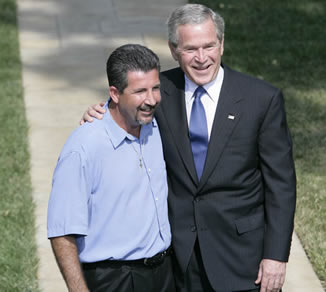
Earlier this week, I had coffee with Rockey Vaccarella in the White House. Rockey is from Saint Bernard Parish in Louisiana, and he and his family lost everything they owned to Hurricane Katrina. Rockey drove to Washington to thank the federal government for its efforts to help people like him. And he brought a trailer along to help remind us that many good people along our Gulf1 Coast are still living in difficult conditions, and that the hard work of rebuilding has only just begun.
 |
|
|
During the storm and in the days that followed, Americans responded with heroism6 and compassion7. Coast Guard and other personnel rescued people stranded8 in flooded neighborhoods and brought them to high ground. Doctors and nurses stayed behind to care for their patients, and some even went without food so their patients could eat. Many of the first-responders risking their lives to help others were victims themselves -- wounded healers, with a sense of duty greater than their own suffering. And across our great land, the armies of compassion rallied to bring food and water and hope to fellow citizens who had lost everything. In these and countless other selfless acts, we saw the spirit of America at its best.
Unfortunately, Katrina also revealed that federal, state, and local governments were unprepared to respond to such an extraordinary disaster. And the floodwaters exposed a deep-seated poverty that has cut people off from the opportunities of our country. So last year I made a simple pledge: The federal government would learn the lessons of Katrina, we would do what it takes, and we would stay as long as it takes, to help our brothers and sisters build a new Gulf Coast where every citizen feels part of the great promise of America.
That was the same pledge I repeated to Rockey during his visit to the White House. This pledge meant stronger levees and rebuilt homes and new infrastructure9. It also means safe streets and neighborhoods filled with locally owned businesses, and more opportunities for everyone.
Next week, Laura and I will return to Mississippi and New Orleans to meet with local citizens and officials, and review the progress we have made. The federal government has conducted a thorough review of its response to natural disasters, and we're making reforms that will improve our response to future emergencies. With help from Congress, we have committed $110 billion to the recovery effort, and we are playing a vital role in helping10 people clear debris11, repair and rebuild their homes, reopen their businesses and schools, and put their lives back together.
The federal government will continue to do its part -- yet a re-born Gulf Coast must reflect the needs, the vision, and the aspirations12 of the people of Mississippi and Louisiana. And their state and local officials have a responsibility to help set priorities and make tough decisions, so people can plan their futures13 with confidence.
One year after the storms, the Gulf Coast continues down the long road to recovery. In Mississippi and Louisiana, we can see many encouraging signs of recovery and renewal14, and many reminders15 that hard work still lies ahead. This work will require the sustained commitment of our government, the generosity16 and compassion of the American people, and the talent and vision of people determined17 to restore their homes, neighborhoods, and cities. We will stay until the job is done, and by working together, we will help our fellow citizens along the Gulf Coast write a new future of hope, justice, and opportunity for all.
Thank you for listening.
END


