


-
(单词翻译:双击或拖选)
This is the VOA Special English Health Report.
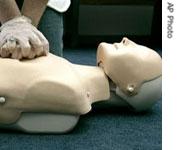 |
CPR combines breathing into the victim's mouth and repeated presses on the chest. CPR keeps blood and oxygen flowing to the heart and brain.
However, a new Japanese study questions the usefulness of mouth-to-mouth breathing.
The study was published in the British medical magazine, The Lancet. Doctors in Tokyo led the research. It examined more than four thousand people who had suffered cardiac arrest. In all the cases, witnesses saw the event happen.
More than one thousand of the victims received some kind of medical assistance2 from witnesses. Seven hundred and twelve received CPR. Four hundred and thirty-nine received chest presses only. No mouth-to-mouth rescue breaths were given to them.
The researchers say any kind of CPR improved chances of the patient's survival3. But, they said those people treated with only chest presses suffered less brain damage. Twenty-two percent survived with good brain ability. Only ten percent of the victims treated with traditional CPR survived with good brain ability.
The American Heart Association4 changed its guidelines5 for CPR chest presses in two thousand five. It said people should increase the number of chest presses from fifteen to thirty for every two breaths given.
Gordon Ewy is a heart doctor at the University of Arizona College of Medicine in Tucson. He wrote a report that appeared with the study. Doctor Ewy thinks the CPR guidelines should be changed again. He said the heart association should remove rescue breaths from the guidelines.
He argues that more witnesses to cardiac arrests would provide treatment if rescue breaths are not a part of CPR. He says this would save lives. Studies show that many people do not want to perform mouth-to-mouth breathing on a stranger for fear of getting a disease6.
Cardiac arrest kills more than three hundred thousand people in the United States every year. The American Heart Association says about ninety-five percent of victims die before they get to a medical center.
And that's the VOA Special English Health Report, written by Caty Weaver7. I’m Bob Doughty8.
 收听单词发音
 |
1
resuscitation
|
|
| n.复活 | |
参考例句: |
|
|
|
|
2
assistance
|
|
| n.援助,帮助 | |
参考例句: |
|
|
|
|
3
survival
|
|
| n.留住生命,生存,残存,幸存者 | |
参考例句: |
|
|
|
|
4
association
|
|
| n.联盟,协会,社团;交往,联合;联想 | |
参考例句: |
|
|
|
|
5
guidelines
|
|
| n.指导方针,准则 | |
参考例句: |
|
|
|
|
6
disease
|
|
| n.疾病,弊端 | |
参考例句: |
|
|
|
|
7
weaver
|
|
| n.织布工;编织者 | |
参考例句: |
|
|
|
|
8
doughty
|
|
| adj.勇猛的,坚强的 | |
参考例句: |
|
|
|


 购买
购买 在百度中搜索