


-
(单词翻译:双击或拖选)
This is the VOA Special English Agriculture Report.
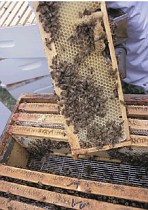 |
Last fall, beekeepers from states with warm climates began to report a sudden loss of honey bees. Losses were reported in twenty-four states and into Canada. Today, some beekeepers say thirty percent to ninety percent of their honey bees are gone. Food prices could go up as a result.
And some beekeeping businesses have failed.
Many kinds of plants, trees and grasses need bees to pollinate them. Bees gather nectar from flowers during this process. The liquid gives them food and material to make honey. As the bees land on flowers, their bodies pick up and drop off fine particles of pollen1. Most flowering plants need pollination2 to reproduce.
Honey bees can die during the winter. But few dead bees have been found. Instead, the bees seem to have disappeared. Experts call the condition "colony collapse3 disorder4."
Agriculture Department official Caird Rexroad said the collapse threatens about fifteen billion dollars worth of the country's farm economy. Mister Rexroad commented at a hearing of a House of Representatives agriculture subcommittee.
Mister Rexroad said the cause of the sudden loss of bees is not clear. The number of honey bees already had fallen before the colony collapse disorder began.
Experts say the varroa mite5 is at least partly responsible for the earlier decrease in honeybees. The mite is a tiny creature that feeds on honeybees. It may play a part in colony collapse disorder by carrying bee viruses. Or the problem may be caused by other diseases and weather conditions.
A group of scientists is examining bees from more than one hundred colonies across the country.
The researchers also are studying the pollen, honey, and wax that the bees produce. They are working with the Agriculture Department's Agricultural Research Service.
Diana Cox-Foster of Pennsylvania State University is part of the scientific group. Miz Cox-Foster says the nation needs honeybees that can defend themselves better against disease and insects. The recent mapping of most of the honeybee's genes6 offers hope of a stronger honeybee some day.
And that's the VOA Special English Agriculture Report, written by Jerilyn Watson. Transcripts7 and audio files of our reports are on our Web site, voaspecialenglish.com. I'm Steve Ember.
 收听单词发音
 |
1
pollen
|
|
| n.[植]花粉 | |
参考例句: |
|
|
|
|
2
pollination
|
|
| n.授粉 | |
参考例句: |
|
|
|
|
3
collapse
|
|
| vi.累倒;昏倒;倒塌;塌陷 | |
参考例句: |
|
|
|
|
4
disorder
|
|
| n.紊乱,混乱;骚动,骚乱;疾病,失调 | |
参考例句: |
|
|
|
|
5
mite
|
|
| n.极小的东西;小铜币 | |
参考例句: |
|
|
|
|
6
genes
|
|
| n.基因( gene的名词复数 ) | |
参考例句: |
|
|
|
|
7
transcripts
|
|
| n.抄本( transcript的名词复数 );转写本;文字本;副本 | |
参考例句: |
|
|
|


 购买
购买 在百度中搜索