


-
(单词翻译:双击或拖选)
Full-time1 virtual schools can now be found in 18 American states. Transcript2 of radio broadcast:
25 June 2008
This is the VOA Special English Education Report.
Forty-two of the fifty American states offered some kind of public online learning this past school year. One state, Michigan, now requires all students to have an online learning experience before they finish high school.
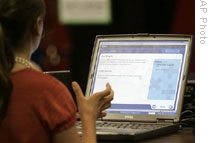 |
| Jessica Miller3, 14, demonstrates the process of a virtual school during an information meeting for parents in Columbia, South Carolina |
Even the idea of a school has changed since the rise of the Internet in the nineteen nineties.
A new report from the Center for Evaluation4 and Education Policy at Indiana University says eighteen states have full-time virtual schools. There are no buildings. All classes are online.
Online learners might work at different times. But there might be set times for class discussions -- by text, voice or video -- and virtual office hours for teachers.
Florida started the first statewide public virtual school in the United States in nineteen ninety-seven.
Today, the Florida Virtual School offers more than ninety courses. Fifty-six thousand students were enrolled5 as of December. Almost sixty percent were female. The school’s Web site says each student was enrolled in an average of two classes.
Two-thirds were also enrolled in public or charter schools. Charter schools are privately6 operated with public money. Other students are home-schooled or in private school.
Florida Virtual School has now opened the Florida Virtual Global School. Students in other countries pay for classes. Janet Heiking teaches an English class. She lives in Indianapolis, Indiana. Her students live as far away as Africa and Japan.
She says they are taking her Advanced Placement class to prepare for attending an American college. They can earn college credits by passing the A.P. test.
So how good are virtual schools? Studies have shown mixed results, as that new report from Indiana University notes.
For example, students at Florida Virtual School earned higher grades than those taking the same courses the traditional way. And they scored higher on a statewide test.
But virtual school students in Kansas and Colorado had lower test scores or performed at a lower level than traditional learners.
Studies also find that virtual schools may not save much in operating costs.
Education experts say the mixed results suggest the need for more research to find the best ways to teach in virtual schools. Also, they say schools of education need to train more teachers to work in both physical and virtual classrooms.
And that's the VOA Special English Education Report, written by Nancy Steinbach. To learn more about computer-based learning, go to voaspecialenglish.com. I'm Bob Doughty7.
 收听单词发音
 |
1
full-time
|
|
| adj.满工作日的或工作周的,全时间的 | |
参考例句: |
|
|
|
|
2
transcript
|
|
| n.抄本,誊本,副本,肄业证书 | |
参考例句: |
|
|
|
|
3
miller
|
|
| n.磨坊主 | |
参考例句: |
|
|
|
|
4
evaluation
|
|
| n.估价,评价;赋值 | |
参考例句: |
|
|
|
|
5
enrolled
|
|
| adj.入学登记了的v.[亦作enrol]( enroll的过去式和过去分词 );登记,招收,使入伍(或入会、入学等),参加,成为成员;记入名册;卷起,包起 | |
参考例句: |
|
|
|
|
6
privately
|
|
| adv.以私人的身份,悄悄地,私下地 | |
参考例句: |
|
|
|
|
7
doughty
|
|
| adj.勇猛的,坚强的 | |
参考例句: |
|
|
|


 购买
购买 在百度中搜索