


-
(单词翻译:双击或拖选)
By Jessica Berman
Washington
28 December 2006
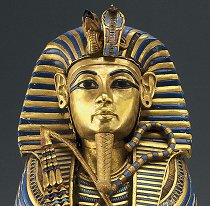
Egypt's boy king Tutankhamun probably died of an infection caused by a broken leg and not a blow to the head as commonly believed. The finding was reached by an international team of scientists that performed a CT scan of the 3,000-year-old mummy. VOA's Jessica Berman reports.
 |
Scientists using a more sensitive form of x-ray technology known as a computed3 tomography, or CT, scanner say it appears the king's skull was completely intact at the time of his death.
Ashraf Selim, a professor of radiology at Cairo University, led the study of the mummy near Luxor, Egypt, where the tomb is located.
Selim says the rest of the mummy was in pieces, having been broken apart in 1922 by an expedition team that discovered King Tut's tomb.
Selim says the team dismembered the corpse4 with chisels5 in an attempt to steal a golden mask that was fused tightly by embalming6 fluid. The mask was one of 5,000 precious artifacts buried with the king.
Had King Tut died of a head injury, Selim says the 1,900 cross-sectional CT images would have showed the two bone fragments inside the skull fused with embalming resin7. But they did not.
Selim says the bone fragments probably came from the upper spine8, which was shattered.
"So, this piece of bone just get inside the cranium and it remained in there for all these past years from 1922 until now," he said.
So, if the Boy King did not die of a blow to the head, what killed him?
Selim and colleagues found a fracture on the mummy's lower left thigh9 bone with a thin coat of embalming fluid around the break, suggesting that the injury occurred before Tut was embalmed10.
Selim believes the fracture could have could have led to the boy king's untimely death.
"Remember that we are talking about 3,300 years ago, and there were not antibiotics11, nothing at that time that were known to these people," he said. "And if we assume that this fracture also has some sort of soft tissue injury, we know, and it got infected by [one] means or another, there is a chance that it got into his blood producing some sort of serious problem that led to his death."
Selim and colleagues presented their findings recently at a meeting of the Radiological Society of North America.
 收听单词发音
 |
1
skull
|
|
| n.头骨;颅骨 | |
参考例句: |
|
|
|
|
2
dispel
|
|
| vt.驱走,驱散,消除 | |
参考例句: |
|
|
|
|
3
computed
|
|
| adj.[医]计算的,使用计算机的v.计算,估算( compute的过去式和过去分词 ) | |
参考例句: |
|
|
|
|
4
corpse
|
|
| n.尸体,死尸 | |
参考例句: |
|
|
|
|
5
chisels
|
|
| n.凿子,錾子( chisel的名词复数 );口凿 | |
参考例句: |
|
|
|
|
6
embalming
|
|
| v.保存(尸体)不腐( embalm的现在分词 );使不被遗忘;使充满香气 | |
参考例句: |
|
|
|
|
7
resin
|
|
| n.树脂,松香,树脂制品;vt.涂树脂 | |
参考例句: |
|
|
|
|
8
spine
|
|
| n.脊柱,脊椎;(动植物的)刺;书脊 | |
参考例句: |
|
|
|
|
9
thigh
|
|
| n.大腿;股骨 | |
参考例句: |
|
|
|
|
10
embalmed
|
|
| adj.用防腐药物保存(尸体)的v.保存(尸体)不腐( embalm的过去式和过去分词 );使不被遗忘;使充满香气 | |
参考例句: |
|
|
|
|
11
antibiotics
|
|
| n.(用作复数)抗生素;(用作单数)抗生物质的研究;抗生素,抗菌素( antibiotic的名词复数 ) | |
参考例句: |
|
|
|


 购买
购买 在百度中搜索