2006年VOA标准英语-Madagascar Prepares for Presidential Elections
搜索关注在线英语听力室公众号:tingroom,领取免费英语资料大礼包。
(单词翻译)
By Scott Bobb
Johannesburg
30 November 2006
In Madagascar, campaigning is winding1 down and voters are preparing to go to the polls Sunday to elect a president. The process has been marked by boycotts2, procedural disputes and a would-be coup3 attempt, but international observers say they hope the polling will be orderly. VOA's Scott Bobb reports from our Southern Africa bureau in Johannesburg.
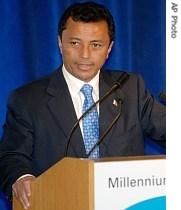 |
| Madagascar President Marc Ravalomanana |
International observers say the process has gone relatively4 smoothly5 despite some notable disputes.
The Director of the Elections Institute of Southern Africa, Dennis Kadima, says a number of candidates have criticized what they say is a lack of transparency.
"They can't understand that the number of voters is only 200,000 more than five years ago, while the population has grown by 3.2 percent every year, so they should have at least 1 million more voters," he noted6.
Kadima adds that candidates are also upset that voter lists have not been published for public review. And they object to the lack of public funds for campaigns and to a law requiring the parties to print their own voting ballots7. They say these measures favor the party in power.
Other political groups are boycotting8 the elections, saying they are being held two months early, which favors the incumbent9 and is unconstitutional. However, the earlier date has been upheld by the Madagascar's Constitutional Court.
The election has also been marked by the government's refusal to allow an exiled opposition10 leader to return home to compete in the polling.
In addition, a soldier was killed two weeks ago in a clash that erupted after retired11 army general Andrianafidisoa [one name] called for the president to step aside in favor of an interim12 military regime.
However, the head of the National Democratic Institution observer mission in Madagascar, Kelley Jones, says that the incident does not seem to have affected13 the elections.
"It appeared to leave everybody's radar14 as quickly as it appeared," she said. "And I don't think that there has been any lingering impact on the populace or the electoral process itself."
The presidential election five years ago resulted in a seven-month-long crisis during which Mr. Ravalomanana and then-President Didier Ratsiraka both claimed victory. The standoff ended when Ratsiraka went into exile in France.


