2006年VOA标准英语-Turkey Warns of Widening Conflict in Iraq
搜索关注在线英语听力室公众号:tingroom,领取免费英语资料大礼包。
(单词翻译)
By Sonja Pace
Istanbul
30 November 2006
U.S. President George Bush went out of his way Thursday to show Washington's support for the government of Prime Minister Nuri al-Maliki as the two men held talks in Jordan on ways to stem the violence in Iraq. The meeting took place amid growing frustration1 within the United States over U.S. involvement in the war, and warnings by Jordan's King Abdullah the unrest could spread throughout the Middle East. Those concerns are shared in nearby Turkey, as VOA's Sonja Pace reports from Istanbul.
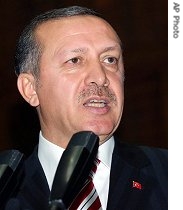 |
| Recep Tayyip Erdogan , 21 Nov. 2006 |
In particular, the prime minister warned against a division of Iraq, noting that would be the beginning of a huge disaster.
Turkey has watched nervously4 as war and sectarian violence have engulfed5 its neighbor. But, what worries Turkey even more is the possibility that Iraq might split into three sectarian units - Sunni, Shi'ite and Kurdish. In particular, the specter of a Kurdish autonomous6 region, or an eventual7 independent state on Turkey's border raises alarm.
Kurds are a substantial minority in Turkey - an estimated 15 million of them live mostly in the impoverished8 southeastern portion of the country. From the mid-1980s, the government fought an all-out war with separatist Kurdish guerrillas for some 15 years, and separatist violence still flares9 up. Almost any actions, or even statements by Kurdish activists10 are seen as a threat to the Turkish state.
Istanbul-based Turkish writer and columnist11 Mustafa Akyol has written extensively about the Kurdish issue, and tells VOA, what happens with the Kurds in neighboring northern Iraq matters very much to Turkey.
"Most Turks think, if there is a Kurdish state in northern Iraq, it will, in a kind of domino theory, influence our own Kurds, and our own Kurds will want to join with them, and, then, we will be losing Turkey's southeastern part, and, there will be a greater Kurdistan, and, Turkey will be losing its territory," he said.
The Kurds are an ancient people in the region and an estimated 20-30 million live today in Turkey, parts of Iraq, Iran and Syria, with smaller communities elsewhere. Promises of an independent homeland after World War I, were never fulfilled. Kurdish uprisings were often brutally12 put down, most notably13 in Iraq during the so-called Anfal campaign that prosecutors14 say killed more than 180,000 Iraqi Kurds in 1987 and 1988, including some 5,000 Kurdish men, women and children killed with chemical weapons in the town of Halabja.
In Turkey, the separatist fight was spearheaded by the Kurdistan Workers' Party, the PKK, whose leader, Abdullah Ocalan, was captured, tried and convicted of treason in 1999. Turkey, the U.S. and the European Union consider the PKK a terrorist organization.
Amid the unrelenting sectarian violence in Iraq today, the idea of splitting the country into sectarian parts has been raised by some U.S. politicians. However, President Bush said Thursday that he and Prime Minister Maliki agreed this is not a viable15 option.
"The prime minister made clear that splitting his country into parts, as some have suggested, is not what the Iraqi people want, and that any partition of Iraq would only lead to an increase in sectarian violence. I agree," he said.
Such statements may come as a relief to Turkey, but political sociologist16 Dogu Ergil of Ankara University says a western-supported, autonomous Kurdish entity17 already exists in northern Iraq, and even that, he says, could prove a threat.
"Given the rate of development by foreign aid and so forth18 … it seems that the place [Iraqi Kurdish region] is the most stable place in Iraq, and it's developing faster than eastern Turkey. And, soon … it could be a center of attraction for the Turkish Kurds, not only economically, but identity-wise, as well," he said.
Many Turks fear that an autonomous Kurdish northern Iraq is just the first step toward full independence. Political scientist, Hasan Uenal of Ankara's Bilkent University, says that is something Turkey could not accept.
"Any attempt to set up a Kurdish state in northern Iraq would be considered by the Turkish state as a vital danger to Turkey," he said. "We would not let that happen. We would not remain idle, and we would do whatever we can to prevent that, to stop that, to kill it off."
Some Turks say they would favor a military incursion to stop that from happening. But, writer Mustafa Akyol says he does not consider a military option likely. Instead, he says, a friendlier approach is needed.
"First of all, we should make our own Kurds happy, so they will be happy citizens of the Turkish state, and they won't need to join a poor Kurdistan in the mountains of Iraq," he said.
Akyol says Turkey has relatively19 little leverage20 to help calm the situation in Iraq. And so, for now, at least, Turkish leaders watch their eastern neighbor closely, and wait to see what happens next.


