voa标准英语2008年-Somalia's Transitional Government Fears Withdra
搜索关注在线英语听力室公众号:tingroom,领取免费英语资料大礼包。
(单词翻译)
Officials in Somalia's transitional federal government are expressing deep concern about the future of the government after its chief military backer and political ally, Ethiopia, announced its intention to withdraw its forces from Somalia by the end of the year. As VOA Correspondent Alisha Ryu reports from our East Africa Bureau in Nairobi, the government is battling for its survival as Islamist insurgents2 close in on the capital Mogadishu and the seat of parliament in Baidoa.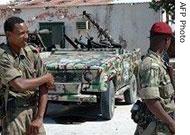 |
| Ethiopian soldiers in Mogadishu, (file photo) |
Somalia's Deputy Speaker of Parliament Osman Elmi Boqore says if Ethiopian troops leave Somalia next month, the government, which depends heavily on Ethiopian forces to protect it from insurgent1 attacks, may cease to exist.
The deputy speaker says an Ethiopian troop withdrawal3 is necessary because it is stipulated4 in a peace agreement signed between the government and an Islamist-led opposition5 faction6 earlier this year in Djibouti. But he says the Ethiopians should not leave before the deployment7 of a more robust8 African Union peacekeeping unit, which can protect the government and maintain security.
There are currently about 3,000 AU troops from Uganda and Burundi in Somalia, who patrol only a small area of Mogadishu.
In late 2006, Ethiopia sent thousands of troops to Somalia to oust9 Islamists from power and install a secular-but-unpopular government made up largely of former factional leaders. Since then, Ethiopian troops have been battling a ferocious10 Islamist-led insurgency11 while factional feuds12, corruption13, and allegations of war crimes and human rights abuses by both Ethiopian and Somali troops have continued to weaken the government and drain popular support.
The situation has also created a humanitarian14 disaster in Somalia, where more than three million people are said to be in critical need of food aid.
The violence has also dampened enthusiasm for the deployment of several thousand more AU peacekeepers in Somalia. And a U.N. peacekeeping force called for in the Djibouti accord has yet to be formed.
For months, Ethiopian officials have expressed frustration15 at the transitional federal government's inability to function as a governing body. Ethiopia says this has allowed Islamist groups, including the militant16 Shabab group listed by the United States as a terrorist organization, to steadily17 regain18 control over most of the country.
Earlier this week during an interview with a local news agency, Ethiopia's Foreign Minister Seyoum Mesfin openly lashed19 out at Somali leaders, saying they "have shown little, or at times, no readiness to shoulder responsibility for the situation in Somalia."
Mr. Seyoum warned that Ethiopian forces would not stay long in Somalia sacrificing themselves in defense20 of the government.
A spokesman for fighters in the Islamic Courts Union, Abdurahim Isse Adow, tells VOA that while he welcomes the announcement of an Ethiopian withdrawal, he remains21 skeptical22 that it will happen.
Adow says if Ethiopian troops, who are seen as an occupying force, left Somalia, it would stop much of the violence and bloodshed in the country. But he says there is still no evidence to suggest that the Ethiopians are serious about pulling out.
Ethiopia says it is committed to the withdrawal plans. But it has assured African Union officials that its troops would remain on the border, ready to intervene again in Somalia if conditions deteriorate23.


