VOA慢速英语 2008 1227
搜索关注在线英语听力室公众号:tingroom,领取免费英语资料大礼包。
(单词翻译)
This is IN THE NEWS in VOA Special English.For much of the year, record prices for oil have made oil-producing nations rich. Now these nations are trying to cut production to support collapsing1 prices.
Last week, the Organization of Petroleum2 Exporting Countries met in Algiers. Members agreed to a record production cut of more than two million barrels a day, or about five percent of world output. OPEC's president said the group may call an emergency meeting in March if prices continue to fall.
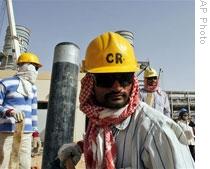 |
| An oil worker at Saudi Arabia's Khurais oil center. Operations at the center were expanded as oil reach 140 dollars a barrel. |
Less than six months ago, oil traded at a record one hundred forty-seven dollars a barrel. Governments and oil companies in Russia, Brazil and Saudi Arabia spent billions of dollars to develop new oil fields. Now, oil is trading for less than forty dollars a barrel—down over seventy percent.
At the root of the sharp price decrease is reduced demand because of the economic downturn. The American Petroleum Institute says demand for oil in the United States fell by three percent in the first half of the year compared to the same period last year. Americans are driving smaller, more fuel efficient cars. And they are driving less.
Last week, the Energy Information Administration released a report on oil use in the United States. The Annual Energy Outlook for Two Thousand Nine predicts that American oil use will remain mostly unchanged through the year twenty thirty. The report says new fuel efficiency rules for vehicles, requirements for increased use of renewable fuels and increased fuel prices will limit demand. The United States is the world's largest user of oil.
Collapsing oil prices mean producing nations will face something they may not have planned for: budget deficits4. Saudi Arabia is the world's largest oil exporter. But it expects a budget deficit3 in two thousand nine — its first in six years.
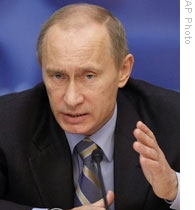 |
| Russian Prime Minister Vladimir Putin at a meeting of the Gas Exporting Countries Forum5 in Moscow Tuesday |
Russia, the world's second largest exporter, also predicts a budget deficit next year. Some nations depend on oil exports more than others. For example, oil provides eighty percent of Iran's foreign income.
Oil was not the only energy resource in the news recently. Russian Prime Minister Vladimir Putin warned that a period of low natural gas prices is coming to a close. Mister Putin spoke6 at a meeting of the Gas Exporting Countries Forum in Moscow. The fourteen-member group includes Russia, Iran and Venezuela.
Currently, natural gas is transported through pipelines7 under long-term contracts. This limits the prices suppliers can charge. But the new process of liquefying natural gas may change that. Mister Putin said liquefied natural gas has become an expanding industry that requires new investment in processing centers.
Venezuela's Energy Minister Rafael Ramirez said the Gas Exporting Countries Forum will have more power over prices as the world market becomes more developed.
And that's IN THE NEWS in VOA Special English, written by Mario Ritter. I'm Steve Ember.


